Sunday, 3 June 2012

Ni Hao China! Part 1- Hong Kong to Guilin.


A man being 'cupped' in a Guilin hutong
Outside the Sun Yat Sen Memorial Hall in Guangzhou, Guandong
Moon and I with a status of Sun himself


I spent a few days in Hong Kong where I did little apart from visit the Chinese embassy, Victoria Park, Stanley Market and St. Stephen's beach. The drive on the bus to the beach took you past Repulse Bay, one of the most exclusive locations in Hong Kong.  I really like this city. Nowhere more clearly typifies the contrast between east and west than Hong Kong.
From here it was a bus journey to Guangzhou ( formerly Canton), about 120 km from Hong Kong. It stands on the Pearl River, and is one of China's biggest and most modern  cities. It has a population of 13 million people and is the largest city in Southern China and the third biggest overall. 
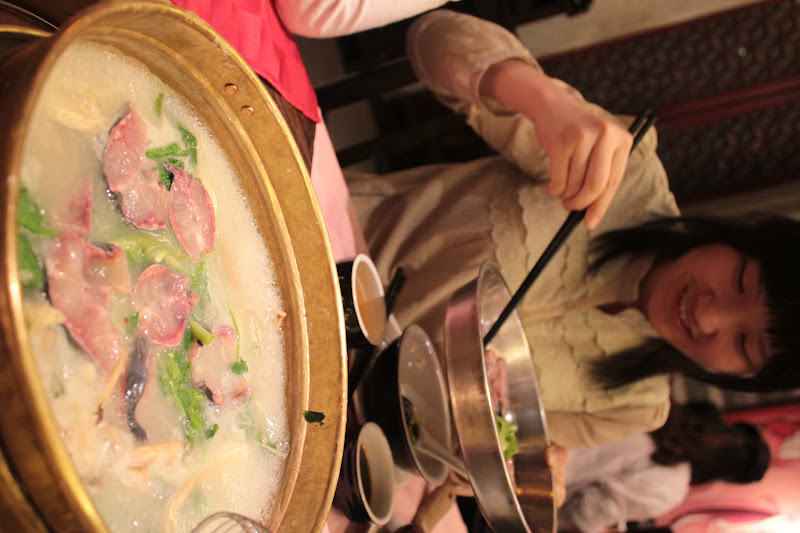
One of the main reasons for going to Guangzhou was to meet up again with Moon and her mum, who I had met in Penang. They were the perfect hosts and after meeting me at my hostel when I arrived they took me straight out got dinner at a local restaurant. It was so lovely to see them again! The following day I met Moon in the morning and we visited Sun Yat  Sen memorial hall.(Sun Yat Sen was one of the founders of the Republic if China). In the afternoon she had arranged to meet some friends at the Baiyan mountain, one of the main attractions in Guangzhou. It was particularly crowded with locals due to it being holiday time in China- the following day was Tomb Sweepers Day ( see below). I had a great afternoon and evening with Moon's friends (see picture) who themselves enjoyed practising their English and telling me a bit about themselves. You learn so much about a Nation and it's people from these type of exchanges. In the evening we had dinner at a local restaurant and wandered by the lake in the Lizhiwan district with its traditional architecture, trees alight with lanterns, river boats all lit up, people doing tai chi and a group of children learning Kung fu. I also managed a further evening out in Shamian Island where we walked  along the Pearl river. We had tea in a traditional  tea house and finished off the evening with a typical chinese meal of  hotpot (see my upcoming food blog)

Moon and her friends


A view from Baiyan mountain
Night time Ghangzhou

Hot pot in Guangzhou


Tomb Sweeping- 4th April. This is a day when families get together to pay their respects to their departed loved ones by cleaning their grave. It is a national holiday in China and makes for a very busy time if you plan to travel!  


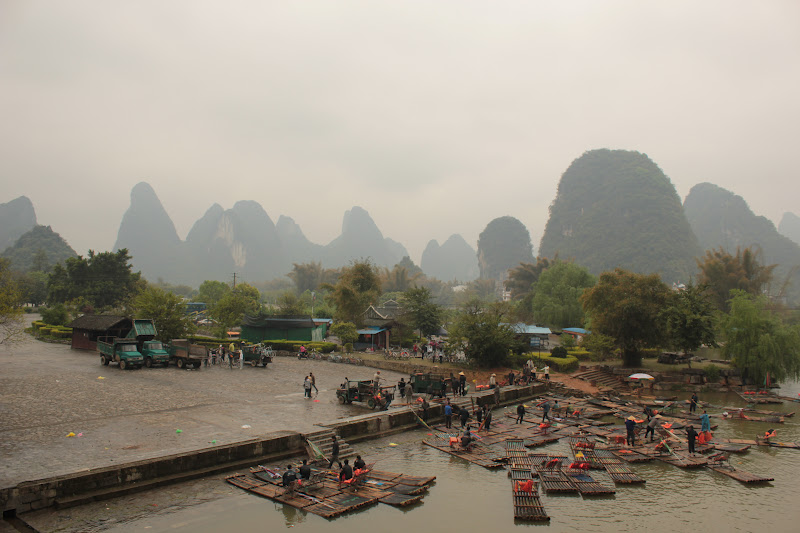
 From Guangzhou I made my way to Yangshou, in Guangxi Province, by overnight bus. This is the area of outstanding natural beauty, nestled in the Karst mountains, that is often featured on postcard images of China. Apart from the weather not being great, you could not help but be stunned by the views. My hostel had a rooftop area that gave a panoramic view of the peaks. Yangshou is a tourist hotspot but I thoroughly enjoyed my time there. Cycling through the dramatic landscape with a group of German people I met in the hostel was a particularly memorable day.
The wonderful hostel in Yangshou


A view of the Karst mountains in the haze
Me and the Germans!
The view from Hostel 11


From here I made my way to nearby Guilin from where I would be taking the train back to Beijing. It is considered one of the most beautiful cities in China and did not disappoint. It is a well preserved walled city nestled amongst the mountains. From here you can do river cruises along the Li river with the stunning scenery all around.
A view from the Li river, Guilin,Guangxi


Sightseeing in Guilin
 Once again I stayed at a great hostel The Ming Palace and had a pleasant day walking along the  river and taking in the scenery. I saw a group of men bracing themselves for a swim and many locals enjoying a Sunday afternoon stroll. Wandering into one of the local hutongs was an interesting experience as the pictures show. In the evening, I was leaving the hostel at the same time as a Chinese couple and ended up joining them for dinner (their treat) and was once again amazed at the generosity shown to me by the people in China.

Mmmalaysia: KL, Melaka, Penang and the Perhentians

KL,Melaka, Penang and the Perhentians.

Malaysia is a country of two halves, split in two by the South China Sea. Peninsular Malaysia to the west, Sabah and Sarawak to the east. It is a hugely diverse nation, kuala Lumpur  being one of the most modern cities in Asia, alongside some of the best islands on the planet with the remote jungle areas in Borneo ( Sabah). I had been to both Peninsular Malaysia and Sabah before but was happy to return.
Malaysians come from a number of different ethnic groups. Indigenous Malays, Chinese and Indians being the main ones. The Malays naturally dominate the government but the economy is run by the Chinese. Malays are almost all Muslims and Islam is the state religion. However, religious freedom is guaranteed here with a mix of Buddhism, Taoism, Christianity and Hinduism co- existing due to its mixed population.

I arrived in KL on a flight from Guangzhou in southern China and when the pilot said it was 25 degrees at 5am, I knew I was in for a bit if a shock. No leg warmers or ear muffs would be required going forward!

I soon found my hostel in the Chow Kit area ( a traditional Muslim quarter a couple of kilometres outside the main sights of the city) and showered before heading out. I certainly needed it after a 28 hour train journey, followed closely by a 4 hour flight.

KL is easy to navigate as its so compact, the main sights within walking distance. Lunch was calling and what better place after noodles for the last few weeks than Masjid India or 'Little India'. I literally stumbled upon a fantastic chapatti house which was full of locals queuing for lunch ( always a good sign) and got a thali of a chapatti, some dahl, chana and brindjal and bagged an outside table from where to soak up the streetlife. Along with an extra chapatti and lassi it came to 5 ringgits ( about one pound) and taking to a couple of locals on their lunch break, they said they had come along after it was featured in the local Timeout!

I headed to the main Medeka Square from where Malaysian  Independence was proclaimed in 1957. It  is surrounded by colonial  architecture and from where you get a great view of Masjid Negara, one of Asia's largest mosques. Here I stumbled upon some filming for what looked like a Bollywood movie. I asked one of the technicians who the star was ( his assistant was holding an umbrella to keep the sun off him between shoots) so I could google him later. I found out in was P Rana - model, former Mr India and now Bollywood star.

The following day I decided to do a day trip Melaka. A great place to wander around and take in the sights and easy to fit into one day. The Portuguese influence is evident in both the buildings and the food They came Melaka in the 16th century, follows by the Dutch in the 17th and finally the British at the end of the 18th. The Chinese also settled here so the population is very mixed.
Penang is one of the great Asian
Islands.it is the oldest of the British settlements, predating both Singapore and Melaka. It had a strategic location between Asia and the markets of the Middle East and Europe. A product of this is it's mixed population, dominated by the Chinese.

The main hub is Georgetown where its backstreets provide the sounds and smells of street food stalls a plenty. I love this part of the culture and never tire of sitting on the side of a street on a wobbly stool eating noodles or rice as I did on my first night. Penang is famous for its food but more about that in my upcoming food blog.

On my first day I went to the largest Buddhist Temple in Malaysia, the Kel Lok Si Temple. It stands on the hilltop at Air Itam and had a seven-tier, 30m pagoda and even bigger bronze statue of the goddess of mercy. There are many temples in Penang, both Chinese and Buddhist. One of my favourites was the Burma  Buddhist temple where I was invited to join in with tea and cake  with a group of locals ( see picture) .

I once again stayed in a great place, the Red Inn on one of the best streets in Penang, Love Lane.More like a boutique hotel than hostel, it oozed chic from the dark wooden floors and bean bags to the contemporary furnishings. And the power shower was a definite winner!
You can find out more at www.redinn.ml *
Whilst Penang is not renown for its beaches ( like Langkawi and the east coast of Malaysia) it does have some  lovely coastline. The best is at Batu Ferringi where I spent many days relaxing. The nice thing about spending longer in one place is you get into a temporary routine. After a leisurely breakfast and bit of sightseeing in the morning I would catch the local bus to the beach in the afternoon. All the locals soon come to recognise you and even though I had no intention of paragliding or renting a jet ski, they like to share in a bit of banter!

I also managed a trip to the National Park on the island and did a hike to a lovely secluded beach with a bunch on people from the hostel. There's nothing like a dip in the ocean when you have built up a sweat walking in the heat. Perfecto.

After Penang I took an overnight bus to the east coast of Malaysia to spend a week or so on the beautiful Perhentian islands. I opted for the smaller and less commercial of the two, Perhentian Kecil. Getting the fast boat early in the morning was particularly special as the scenery as the island comes into view is absolutely breathtaking as the pictures show.
I ended up spending 8 idyllic days here, on Coral beach, made even better by the fact that people I had met in Penang came to join me. Sharing a room with Linda at the Shari La resort was an added bonus, and along with Tamara and Tina who arrived a couple of days later, we had a great time. The resort had its own private beach, or a series of bays , where we spent most of our days chilling out or snorkelling , and a couple of evenings out on Long Beach on the other side of the island. It was a very memorable time and the images I've included here show just why it's such a special spot. As I told Rudi, the manager of the resort, I will be back, one day!

Tuesday, 28 February 2012

Xie xie Xi'an

A close up of one of the Terracota Warriors at the Shaanxi Museum
The biggest hanger at the site in Xi'an where over 8000 Terracota Warriors have been discovered

One of the smaller pits from above
                                                                             Me at the entrance to the south gate of the wall around Xi'an- with panda!

Colourful goods on sale at a street market
A wonderful scene from the Muslim Quarter

Xi'an is a city in Shaanxi province in the centre of China, an overnight train journey from Beijing. It is a city of huge historical and cultural significance. As one of the oldest settled regions in China, human habitation here dates back to prehistoric times. It is also the place where China's first dynasty, the Qin, called home. There are 35,000 (yes, you read that correctly! ) historical and archaeological sights here in Shaanxi. Later both the Sui and Tang dynasties built their capital in Xi'an and it remained the political heart of China until the 9th century. It was also of huge economic significance as it was the Eastern terminus if the Silk Road, bringing trade goods to China and the East from the West.

Shaanxi History Museum was a good starting point. It takes you through the history of the China, from it's prehistory through the dynasties including the creation of the first dynasty in China, the Qin. There are lots of artefacts ( some similar to those in the Shanghai Museum) including a handful of the Terracota Warriors.
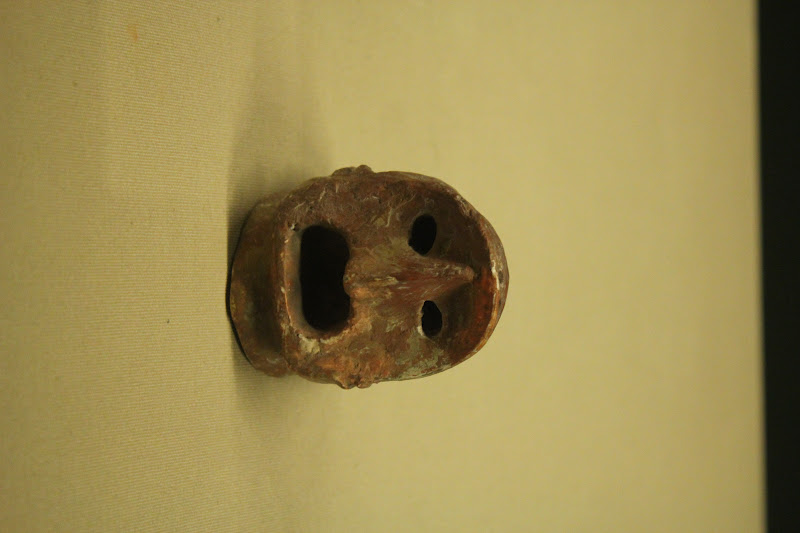
One of the artefacts in the Shaanxi Museum, a pottery head of a man dating from between 5000 and 3000BC. Sarah and I thought it looked like Morph!

Big Goose Pagoda was another place on our hostel tour. Built during the Tang dynasty in around 648 AD, it stands surrounded by water features which are the setting for a water and light show each evening. I went to see this with Carli and Kayleigh from the hostel on my last evening (see picture)

No trip to Xi'an would be complete, however, without a trip to see the famous Terracota Warriors. Along with the Great Wall and Forbidden City, this makes up the 'Big Three' of any trip to China. Discovered by a farmer digging a well in 1974, this was probably the most important archaeological find of the 20th century. Today you visit a series of hangers where thousands of clay warriors ( 8000 discovered so far) and their horses in battle formation dating back over two thousand years to the Qin Dynasty. Many of the warriors held weapons that have also been painstakingly restored.
The soldiers are in ranks and strict attention is paid to the battle dress of the day: generals, archers, cavalrymen and officers. Signs such as whether they had nails in their shoes indicates their rank as does hairstyle, dress and positioning. It is speculated that the sculptors may have used their own faces as models.It is also said that they  were put to death in the completion of the warrior.

We also got to visit the hill which houses the tomb of China's first emperor and for whom the warriors were created, Qin Shi Huang.
The light show at the Big Goose Pagoda
Some of the delicious street food you find everywhere in China. These dmplings were some of my favourites  (thanks to our guide, Angel)
On my first day in Xi'an I went with a group from the hostel to the museum and onto the Big Goose Pagoda (pictured here). There were a group of travellers from Poland, Angel (our guide), Sarah and myself. A great start to my stay in Xi'an. We are all doing the Chinese salute!

One of the themed evenings at the Han Tang Inn (http://www.itisxian.com/hantang/index.htm)

Carli, me, Kayleigh, Claire and David at the Han Tang Inn. I had a wonderful few days there.


I spent an extra couple of days in Xi'an due to the trains being fully booked. However, I had a great time as the hostel (the Han Tang Inn) is without doubt one of the best I have ever stayed in. The atmosphere and themed evenings ( sauna evening, learning how to make Chinese dumplings and playing Chinese games) made it so memorable, alongside meeting some lovely people, including Argentinian student Carla and fellow Brits Kayleigh, Claire and David.

Xie Xie Xi'an!

Next stop: Guangzhou then KL

Friday, 24 February 2012

Bullet to Beijing!

The image of Chairman Mao at the Gates of Heavenly Peace- the entrance to the Forbidden City
The Bullet Train

Always being asked to appear on photos, this one over looking the Forbidden City
Suitably wrapped up on the shores of the frozen lake at the Summer Palace


I started my journey to Beijing aboard the bullet train which was a great experience, these trains go twice as fast as anything at home.I had booked into Sleepy Hostel, a recommendation that I am grateful for as the location was superb, in the Jishuitan area by a beautiful lake ( which like all the other lakes in Beijing was frozen over for the whole of my stay and I saw people skating, taking walks and playing ice hockey every day on the frozen ice)

Beijing's history is rich and it emerged as a political and cultural force following Mongol occupation in which Genghis Khan razed the city to the ground in 1215 having penetrated the Great wall. His grandson Kublai Khan reigned over the largest Empire the world had ever known on the site of present- day Beijing. Affectionately known as Peking in the days of colonialism( still called this today by many Chinese) it has also been known as Dadu ( Great Capital) and by the Mongol name Khanbalik ( Khan's town).During the Ming dynasty it was renamed Beiping- the only pure Chinese dynasty to rule from the city. During Ming rule hallmark architecture such as the Temple of  Heaven and the Forbidden City date. Beijing's hisory is indelibly linked to that of China and was subjected to power struggles and invasions from amongst others the Anglo- French,the Boxers, warlords, the Japanese and Kuomintang. It changed hands one last time on 1st October 1949 when the People's Liberation Army entered the city and Mao Zedong proclaimed a People's Republic to 500 000 citizens in Tiananmen Square.
Beijing today has retained its historical core with the Communists leaving their own Stalinesque touches alongside the modern day skyscrapers and shopping malls that have transformed it.

It's size is formidable- roughly the size of Belgium- and is one giant grid with the Forbidden City at its centre.

On my first day I started at the symbolic heart of Beijing, Tiananmen Square. It's the largest public space in the world and did not disappoint. It was quite overwhelming as it obviously means so much to Chinese people and big groups were everywhere capturing the moment. I can honestly say I didn't see another Westerner until a couple of hours later as I left my bag before visiting Mao's mausoleum! ( see separate section). The Gate of Heavenly Peace is at one end of the square, hung with a vast likeness of Chairman Mao, and from where he proclaimed the People's Republic in 1949.
*Mao died in September 1976 and his mausoleum constructed immediately after. Still revered by Chinese people today, it is a place of pilgrimage for many Chinese. No bags or photography are allowed and you are rushed through at breakneck speed. Debate rages as to whether its Mao's actual body or a waxwork! One thing I did notice is that he seemed remarkably small although the history books tell us he was just short of 6 feet! Believe what you will..
Next stop was the Forbidden City or Dongcheng to the Chinese, now known as the Grand Palace, directly behind Tiananmen Square.
This is the largest and best preserved group of ancient buildings in China and home to the Ming and Qing dynasties. The largest and most important hall at the heart of the Forbidden City is the Hall of Supreme Harmony, built in the 15th century and resorted on the 17th, it was used for important ceremonial occasions such as the Emperor's birthday and coronations. The Supreme Harmony Gate also overlooks a courtyard that could hold audiences of up to 100,000 people giving you some idea of the scale of this enormous complex of halls, temples, bridges and gardens.Simply stunning. Immediately after leaving the Forbidden City I headed straight over to Jingshan Park which gives priceless views back over the City.It did not disappoint despite it having been a hazy, cloudy day.

A section of the Great Wall at Jinshanling


On my second day I visited the Lama Temple, the second largest Tibetan temple in the world. It's an active temple where locals congregate to pay their respects to Buddha.My Chinese friend John visited the temple to say thank you upon finding out he has a place at an American university to study for his Masters!

Another site I visited was The Summer Palace , a wonderful place to spend an afternoon, walking along the frozen lake to the famous bridge and admire the stunning setting.

No visit to Beijing would be complete without a trip to the Great Wall. I visited the Jinshanling  section  of the wall which was less touristy than some of the more popular sections.It was about a 3 hour drive from Beijing so after an early start we arrived at  our destination having glimpsed sections of this iconic structure as we approached .I had a wonderful day ( one of the best in China so far) as the scenery was stunning and I was in such a historical place. The Great Wall is also known to the Chinese as the 10,000 Li Wall ( one Li is about 500m ) which makes the wall  roughly 5000km stretching from Liaoning Province to Jiayuguan in the Gobi Desert. The original wall aawas begun over 2000 years ago during the Qin dynasty when China was being unified as a way of keeping out nomads and invaders. Hundreds of thousands of labourers worked to their deaths in its construction. Although it never performed well as a defensive structure ( Genghis Khan said the strength of a wall depends on the courage of those who defend it) but it did work well as a transport link.
Sections of the wall no longer exist as it was largely forgotten although many have been rebuilt for the tourist industry. I was really pleased that I got to see an original and unrestored section of the wall and we didn't see any other tourists all day. It is in sharp contrast to the most popular and dramatic section at Badaling which has a cable car, souvenir stalls and a fairground feel. However, it is a myth that you can see the Great Wall from space. The first Chinese man in space confirmed this in 2003!
                                        A view of the Great Wall in all its glory
The group who I shared the day wit- me, two American sisters, an Australian couple and our guide
This man climbed to the Flower Tower everyday to sell drinks and trinkets. He was 74 years old, a fact he was keen to share. There's a lot of living in that face!

I met some great people in Beijing which again added to my experiences and enjoyment. Scott, an American studying Chinese and his Chinese girlfriend Rachel ( many Chinese also have a Western name), another American guy David, in China to teach, and a great Chinese guy who spent days showing me around areas such as the 798 Art District ( a former industrial area that has been transformed with a thriving art scene, cafes and funky shops), the Confucius Temple and Beihai Park as well as many hutongs ( narrow alleyways on the traditional Chinese style) . There were once said to be 8000 in Beijing although many were taken over in preparation for the 2008 Olympics. These thriving communities are wonderful to wander or cycle and every rickshaw driver shouts 'Hutongs' at every street corner!
I was also impressed with the cost of things in China. I love eating at street stalls and local restaurants - I think the cheapest I found worked out at 60p for a big bowl of noodles with egg, tomato and greens.Similarly the cost of transport- a ticket anywhere on the Beijing subway will set you back 2 juan ( about 20p) and my cheapest bus ticket worked out at 4p!
An ice hockey game on my local lake
Me at the 798 art district sign doing my Chinese salute!
Me and my Chinese friend Johnny (who I met at Sleepy Inn). He showed me lots of places around Beijing, always good to know a local!
Johnny again (most Chinese have an English name to use with foreigners!)

Next stop: Xi'an

Wednesday, 22 February 2012

First stop: Shanghai

Walking along the Great Wall of China- all will be revealed in my next blog!

Just one of a million artefacts in the best museum in China
The early coins on display at the Shanghai museum


My Chinese journey began in Shanghai ( after an 18 hour train journey from Hong Kong where I slept most of the way as my bunk/ hard sleeper didn't allow me to sit up!)
 China's largest city has a population of 23 million and it clearly typifies  the contradictions of modern China. Glitzy department stores and skyscrapers on the one hand, poverty and prostitution on the other. China has the biggest gulf between rich and poor in the world.

Shanghai doesn't have the history of other Chinese cities but it's a great place to feel the pace of modern China. Even from my limited time in the city, wandering down East Nanjing Road with its big named stores- Cartier, Louis Vuitton, etc then turning into a side street where street vendors, local cafes and stalls selling anything and everything predominate. It really gave you a sense of East meets West, the modern and the ancient.

It's name means by the sea and as the gateway to the Yangzi river it was an ideal trading port. By the 1930s it was the busiest international port in Asia thanks to the British ( and later the French and Japanese). It was a city built on the trade of opium, tea and silk.

Shanghai's has both historical and contemporary importance. It was where the Chinese communist party was formed in 1921 and during the Cultural Revolution it was the power base of the 'Gang of Four'. Many of todays leaders hail from the city. Central government would love to see Shanghai viewed as the the leading city in China, rather than Hong Kong (as a former British colony).Time will tell..

So my introduction to China was in Shanghai. After finding my hostel ( the wonderful Blue Mountain Bund) with a little bit of help ( thank you to a lovely German guy who pointed me in the right direction as Chinese road signs are not always that helpful) ! I set about exploring the immediate area and was soon to discover what a great spot I was in. East Nanjing Road is at the end of the street- one way to People's Square, the other way the Bund. Two of the most important areas in Shanghai. One my first full day I headed to the Shanghai museum having heard that it is a must and you need at least half a day. It did not disappoint.
Established in 1952 it is a world famous showcase for Chinese art. It houses one million exhibits in sections including bronze, ceramics, paintings, calligraphy, jade and ivory.

I particularly loved the bronze and ceramics sections. As a history teacher I was aware that ancient Chinese civilisation was well ahead of its time but even so I was amazed at the craftsmanship of artefacts that were over a thousand and in some cases several thousand years old. I've included a tripod Ding (used for cooking) which weighs over 200 kg. It is extremely rare and suggests the power and influence of the nobility for whom it was created in the 11th century BC.

Another area of interest was the coinage system. China is known as the birth place for paper money but it's history of coins goes back before the 3rd century BC with its first cast coins followed by round coins with central holes from then on. It's first paper money was introduced from 960AD. (see pictures) .The ancient Silk Road coins help record the economic history of the ancient nations along the Silk Road.

I also visited the Propaganda Museum which showcased posters from the days from when the Republic was proclaimed up until the time of Mao's death. There were lots of posters in chronological order with
examples of utopian life and anti-capitalist anti Western sentiment as you would expect. Having studied some Chinese History, I could identify with the Cold War images of Mao alongside Stalin, Lenin and Marx, the importance of images in History never clearer.


One of the many images of Chairman Mao in the Propaganda Art Museum

The views along the Bund. I'm sure they would be better if it wasn't raining!

I wandered the area known as the French Concession where there was a real European vibe.  Shanghai's reputation  as the 'Paris of the East' evolved from here. Walking down the tree- lined streets with imposing European villas , you realised that this is certainly a chic area of town. I imagine in summer it would be wonderful here, with green on the trees and alfresco dining.

Another highlight was the Jade Buddha temple, Shanghai's most famous. Pyres were being lit and incense being burned, the importance of religion so obvious yet the atmosphere felt strangely at odds with the mass consumerism on the streets beyond.

I loved Shanghai- the hostel, atmosphere and simply experiencing the 'real' China only a few streets from the main shopping area and sights.

Next stop: Beijing

Wednesday, 1 February 2012

Farewell Land of Oz, Hello Hong Kong

Relaxing on the grass at the Australian Open

The show I went to see in Macau featuring my friend, Anaelle


I had a slight change of plan following my stay in thye West in that I decided to return to Melbourne for a few days. My friend Nat had managed to get tickets for the Australian Open tennis event and that was an offer I couldn't refuse. Although it was only a day pass for the outer courts, it was the day of the women's semi finals so we were able to follow the action on the big screens. Bands played and drinks flowed, there was something of a carnival atmosphere about the day.

I spent 3 days back in St. Kilda, enjoying the vibe and relaxation of Nat's local beach before heading back to Sydney for my last day and night. It was great to see Matt and Bridget again and my last evening was ever eventful, being treated to tacos and drinks by a group of their friends in the trendy Surrey Hills area of the city.
Once again I have been humbled by the generosity of people on this trip and my heartfelt thanks go out to all those who have looked after me. You know who you are!

So, next stop Hong Kong. Matt and Bridget dropped me off at Sydney Airport ( it was another emotional farewell) for the 9 hour flight. I had booked a hostel in the Kowloon area of the city, in the Chungking Mansions ( rather notorious as it's a cramped high rise building where locals and backpackers co-exist and has a somewhat seedy reputation). I had heard horror stories but have to say I was pleasantly surprised. My hostel is cramped for sure but clean and the location, on Nathan Street, in the heart of the commercial hub of Kowloon, suits me.

Hong Kong is now part of China (the area was ceded from British rule in June 1997) although has retained independent status. It's name means Fragrant Harbour. It comprises a number of offshore islands, Hong Kong and Kowloon being the principal urban areas. Kowloon is the southern part of the peninsular and Hong Kong the island off it.This is the main financial and commercial quarter.

On my first full day in Hong Kong, I left to go to the island of Macau. Like   Hong Kong, Macau is a former European colony although belonged to Portugal. In 1557 it became the first European settlement on the Chinese coast.It was returned to China in December 1999  after 442 years of Portuguese rule. Many say it was more historically significant than the Hong Kong handover in that the Portuguese were '  the first in and last out!'
Macau is known as the Monte Carlo of the Orient due to the huge numbers of casinos here which underpin the economy.It is also known as an area where prostitution and criminality flourish, the Triad gangs in particular.
Macau is 95 per cent Cantonese and less English is spoken here than in Hong Kong.

The reason for my visit was that my friend Anaëlle had got me a ticket to see the show she was performing in, The House of Dancing Water. This show has been created by Franco Dragone (of Cirque du Soleil fame) and has been running since September 2010. Anaëlle ( who I had met on a bus in Cambodia) had got me super tickets and the show completely mesmerised me. Made up of acrobats, gymnasts, divers and daredevils, the dancers are in a minority in this show! Some of the stunts performed leave you gasping as the performers dangle from trapeze swings and dive into the pool from great heights. To read more about the show the link is http://www.thehouseofdancingwater.com/. Or try finding a clip on youtube.


After the show, it was wonderful to see and catch up with Ana who treated me to cocktails at the Atari Tower hotel which gave awesome views of the city of Macau, lit up by night. As we walked back to her apartment I felt like I was back in Europe as the Portuguse architecture is evident everywhere. The next day I had a few hours to explore the centre of Macau with the old city centred around Largo de Senado (Senate Square) with its beautiful Portuguese buildings mixed with Chinese culture- everywhere there were signs of the Chinese New Year which I had missed by only a few days.

The main square in Macau where there were signs of the recent New Year

Back by ferry in Hong Kong I spent a couple of hours at the Chinese Embassy ( sorting my visa) before getting the Star Ferry back to Tsim Sha Tsui which gives amazing views of the Hong Kong skyline. I took a trip to Lantau island to see the largest outdoor seated Buddha in the world (see picture) which also has some breathtaking scenery and to Victoria Peak with its stunning views of the city.


The Star ferry makes the run between Hong Kong Island and Kowloon every few minutes

The big Buddha at Lantau


More than anything, Hong Kong is a place to wander. As always in Asia, there are food stalls everywhere selling everything from tea to juices of every description to weird looking satays and colourful sweets.Like in other parts of Asia, it's all about the food and people seem to never stop eating! I felt like a local when I was using chopsticks with one hand and was playing with my phone with the other!

Next stop: China