Saturday, 7 July 2012

Hello India! Part 3 - Goa and Mumbai

Boys playing on Palolem beach, south Goa
Palolem beach in Goa- the sun did eventually come out
A welcome cup of Earl Grey (my favourite tea ever)  at the  Cheeky Chapatti restaurant in Palolem Beach


The SE Cathedral in Goa
The beautiful Cathedral in Panjim, Goa


I eventually left Hampi, knowing that this place will remain in my thoughts for a long time to come. The town is going through a huge transition as its people are in the process of being relocated to a 'new' village a few kilometres away. The plan is to eventually move all the businesses and inhabitants of the town to this new location. The process is evident, with many buildings already demolished and the place is abuzz with talk of what the government has decided will happen. Many people are losing their traditional way of life and businesses built up over generations. The balance between preserving historical monuments and the rights of inhabitants in such areas remains one that is difficult to manage without a human cost.

I have attached a link about the issue to this blog entry. 

From Hampi I took an overnight train to Madgoan, the transport hub for Goa and headed south to Palolem beach. Despite the rain ( it is now the monsoon season) I loved walking along the beach with the sand between my toes. There was still life in the place and I found a room at a guesthouse right on the beach itself. There were a few other travellers around but it was a relatively quiet couple of days of reading, enjoying lovely food - I particularly liked the 'Cheeky Chapatti' restaurant ( see picture attached) - and being mesmerised by the view of the sea from the veranda of the guesthouse. And the sun did eventually come out so I managed half a day of beach time. 
I had met Victoria from the US on my first day in Goa and she asked if I wanted to share a trip she was doing by car to Panjim and Old Goa. It sounded like a plan. 

About an hour north of Madgoan, our first destination was Old Goa. Goa itself was  used by the Portuguese as a base from the early 16th century when they tried to control the spice trade from the East. Jesuit missionaries led by St. Francis Xavier arrived in 1542. Today it is hard to believe that back in the 1500s the population exceeded that of Lisbon and London. So today, it's like a bit of Portugal has been dumped in India, it's influence all around. Old Goa has a number of churches to visit, including the imposing St.Francis of Assisi church and the SE Cathedral. From there it was onto Panjim ( formerly Panaji) , the capital of Goa. After a lunch at a local cafe we did a walking tour which began at the Cathedral and made its way through the heritage area of town where the colonial architecture is at its best. We marvelled at the colours of the buildings and the 'European' feel of the place. We stopped for refreshments at a beautiful art gallery cum cafe. And weaving our way up the steps of a temple dedicated to the monkey god Hanuman,  we took in fantastic views of a very lush and green landscape all around.

I thoroughly enjoyed my day with Victoria. She is great and engaging company. And I particularly enjoyed being picked up and driven around all day. After local buses, my usual mode of transport,  I felt like a VIP! 
Colonial buildings on theHeritage Trail in Panjim, Goa
The Hanuman Temple In Panjim
The Taj Palace Hotel in Mumbai
At the famous Gateway of India, Mumbai
A mural in Mumbai
Mumbai  architecture
Saturday afternoon strollers on Marine Drive
Chowpatty Beach

And so, to Mumbai , or Bombay as it was known during the Raj , a settlement that  was ceded to the British by the Portuguese in 1661 who themselves had received it from the Sultan of Ahmedabad.  Strategically significant, it's location on the Arabian Sea have made it the principal gateway to the Indian sub-continent since the opening of the Suez Canal. It is the capital of the Maharashtran region and has the label of being India's most dynamic and westernised city. I have to say, my first impression  arriving in the Colaba District was one of Am I still in India? It is the principal  home of India's business, industry and commerce and of course, it's film industry 'Bollywood'. It's crammed into a peninsular and gives the impression of a metropolis desperately short of space. But it's a city where the extremes ate most acutely felt- the urban uber rich rubbing shoulders with the desperate poverty of some of the worst slums in India. it has also been associated with home grown terrorism in 1993 when ten massive bomb blasts ripped through the heart of the city, killing 260 people. And again in 2003 when a car bomb exploded near the Gateway of India, killing 107 people. No one claimed responsibility for either attack although Muslim militants were suspected. 

My stay was a short one. After finding the legendary Red Shield Salvation Army hostel and dropping off my bags, I set off to explore the immediate area. Colaba is the main tourist district and trendy hangout full of bars and restaurants. Within a few minutes I was at the Gateway of India (see photos) commemorating  the visit of King George V and Queen Mary in 1911. The arch was built in 1924 and is India's very own Arc de Triomphe. It is remembered also as the place the British chose to stage their final departure from India in 1948. Directly behind it is the Taj Mahal Palace and Tower- a showcase of local pride against colonial oppression. The industrialist who built it is said to have some so as an act of revenge after being refused entry into the ' whites only' Watson's Hotel. As I visited it was packed with largely Indian tourists posing for the obligatory photo in front of these two iconic Mumbai monuments.
 The rest of my day was spent wandering in Colaba, particularly the street bazaar, and them making my way to the Churchgate and Fort area which contains some wonderful Raj architecture - the site of thr British era's oldest buildings- such as St. Thomas' Cathedral , the GPO and the Victoria Terminus, inspired by St. Pancras Station in London. I had lunch in a quirky little Iranian restaurant that had been recommended by another traveller called Britannia and Co.

My time in Mumbai was limited but I thoroughly enjoyed my day there and was definitely left thinking that I should have stayed longer. Taking a cab to the station, the driver talked me into a detour via Marine Drive and Chowpatty Beach, two Mumbai institutions. This stretch is popular for afternoon and early evening strolls. As it was Saturday and late afternoon, the area was buzzing with life. A great way to complete my short sejour in Mumbai.

Next stop : Delhi then Amritsar  

Monday, 25 June 2012

Hello India! Part 2: Mysore and Hampi

I arrived in Mysore, in the Indian region of Karnataka, on a rainy Sunday evening, spending the night at Mysore Youth Hostel where I met Elo, a fellow traveller from Estonia. We shared a rickshaw into town the following day and breakfasted on marsala dhosas before going our separate ways. Whilst I managed, despite the rain, to visit the undisputed highlight of Mysore, the Maharaja's Palace (see picture), I did not manage to climb the viewing point, Charmundi Hill. The late afternoon was spent wandering the backstreets, the Muslim Quarter and the bazaars of Mysore, one of the most famous being the Devaraja Market. From Mysore, it was an overnight bus (again) to Hampi. 
I couldn't quite have prepared myself for what awaited me in Hampi. The bus dropped me off in nearby Hospet, and from there it was a thirty minute bus ride to my destination. Hampi is simply stunning. The tiny bus station by a small market must be one of the most picturesque the world over. The landscape is both alluring and magical.Huge copper coloured boulders dot the landscape, shaped by thousands of years of volcanic activity. Hampi is a gem of southern India, a World Heritage Site and major destination on the backpacker trail. And there are temples a plenty.scattered over a wide area of what was once the Hindu capital of India, Vijayanagar. It evokes memories of a bygone era - of opulent palaces, beautiful temples, monolithic monuments, aqueducts, baths and markets.
I arrived early and ate a local breakfast of curry and idly sitting on a stool and taking in the wonderful views. One I had found my accommodation, I did a bit of exploring in the immediate vicinity and ended up at the Virupashka Temple with its huge 50m Gopuram which dominates any view of Hampi. 
One of the great things about Hampi was that there are other travellers to meet- even now in the 'low' season. Within a couple of hours I had met fellow travellers and was eating lunch at the riverside restaurant the Mango Tree (where I was to eat at least once a day over the forthcoming week). Following this, I crossed the river to climb the steps of the Hanuman (Monkey God) Temple which afforded amazing views of the surrounding boulder-strewn landscape.

Cycling in Hampi - a great way of exploring the area

Outside the Maharaja's Palace in Mysore
The beautiful colours of  one of Mysore's bazaars, the Devaraja Market.


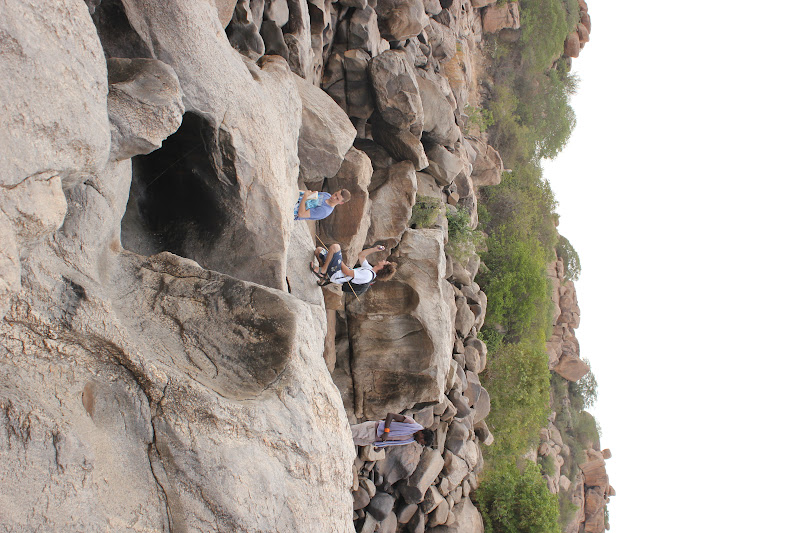
Bouldering in Hampi with the boys 
and posing for pics..

The Lakshmi Narasmiha Temple - a monolithic incarnation of Lord Vishnu  in his man-lion form
The amazingly well preserved bass reliefs of the Hazararama Temple depicting scenes from the Hindu epic, the Ramayana
Outside the beautiful Lotus Mahal
My favourite, the Elephant Stables, with eleven large-domed stables  which once housed the magnificent state elephants
A magnificent stone chariot in the courtyard of the Vitala Temple
The focal point of Hampi Bazaar, the Virupaksha Temple
The copper coloured boulders of Hampi
Over the preceding days - I like many others 'lingered' in Hampi- I made trips to swim in lakes, clamber over boulders and cycle to the main sites. I've included pictures here of some of the highlights : the Lakshmi Narashima Temple, the Hazararama Temple and my favourite, the Zanana Enclosure, which includes the Lotus Mahal (which derives its name from its beautifully and geometrically arranged cusped arches that resembe lotus petals opening to the sun) and Elephants' Stables. There is also the highlight of any visit, the Vitala Temple which is seen as Hampi's crowning glory.

I've had an unforgettable week in Hampi and it is down to the friends I have made here too. Thomas, Robert, Daniel, Tamlin, Charlie, Mark, Christelle and last but not least, Mr. Tom and Jerry himself, the ever friendly face of Ravi's Rose Guesthouse.

Next stop: Goa 

Sunday, 17 June 2012

Hello India! Part 1- Tamil Nadu

Yours truly at one of the most famous Hindu temples in  Madurai
 A boy at the station in Madurai who introduced me to his whole family, keen for me to take a whole series of 'family' portraits. Here with his younger brother.
One of the many group pictures I took of the children in the backstreets of  Pondicherry
Being 'blessed' by an elephant in Pondicherry

 A holy man at the Sri Meenakshi Temple in Madurai

A scene from the station at Madurai
I arrived in India via KL on an early morning flight. My first experience was chai and tiffin (a dish of 3 different curries and a roti- very popular in India) followed by a bus from the airport to a central Chennai bus station. I ended up having to take two further buses, and if you can imagine my with my huge backpack, a smaller rucksack and camera bag trying to get on a bus that is packed to the gills and barely stops in stifling heat. Hello India!

Chennai doesn't hold much to tempt the tourist but its a great introduction to a crazy Indian city. I got a local bus (again) to its main beach, Marina beach, and saw the community which had been devastated by the tsunami in 2004. People here are still living in makeshift homes and in incredible poverty, something you have to get used to in India. The beach here attracts locals at the end of the day  and I did a walk along the ocean front path taking in the sights, sounds and smells.

From Chennai I took a bus to nearby Mamallapuram, famous for its Shore Temple and rock carvings, and from there to Pondicherry. This town is a very French-influenced part of Tamil Nadu and is famous for the Sri Aurobindo Ashram, set up by a Tamil freedom fighter called Sri Aurobindo Ghose who was given shelter from the British in Calcutta. He went on to set up the ashram which attracts devotees from all around the world. A French holy woman  and disciple of Sri Aurobindo, Mirra Alfassa (the Mother) set up a utopian living experiment at nearby Auroville that is still thriving today. Even today you can join locals eating at the ashram (I did this, three meals for 20 rupees) and visit the working ashram at Auroville as a guest.

I ended up staying a few days in Pondicherry as I loved where I was staying- the Maison Natura ashram - which was in a neighbourhood on the edge of the town centre. Everyday I was mesmerised by how the ordinary people lived here - women washing using the taps in the streets, babies being bathed,  the ironing man using an iron you heat on the fire and the animals who shared the street and houses! It was like stepping back in time, people still living like they have for centuries although now with some of the conveniences of 'modern' living. And the children were adorable, mobbing me every time I walked down the lane. They loved having their pictures taken as the many photographs show.

From Pondy, I made my way to Madurai which is one of the oldest cities in India with a very famous Hindu temple, the Sri Meenakshi temple, where people from all over India flock to visit each year. And then it was a train journey to Kanniyakumari, unique in that it is the only place in the world where three seas meet - the Bay of Bengal, the Arabian Sea and the Indian Ocean. It is also special as you can see the sun rise and set within a few metres of each other. It has been an important place of pilgrimage for this reason and there are two monuments you can see from the shore to commemorate this - the Vivekanada Rock Memorial and the 133 metre high Thiruvalluvar Statue which you visit by a short ferry ride. Other important sights here are the Gandhi Memorial where Gandhi's ashes were put on display before being scattered into the confluence of the three oceans after his death in 1948. The memorial has been designed with three faiths in mind, Muslim, Hindu and Christian- and has a hole in the roof so positioned that on the 2nd October (Gandhi's birthdate) the sunlight falls directly onto the permanent memorial below for a few hours.
The view from my guesthouse at Kanniyakumari
The Gandhi Memorial at Kanniyakumari
The temple at Suchindrum, a short bus ride from Kanniyakumari

My last stop in Tamil Nadu was the famous hill station of Ooty, an overnight bus journey from my previous destination. I woke from my sleep to find the bus was winding its way up a steep incline and as I looked bleary eyed out of the window I was welcomed with the beautiful sight of clouds shrouding the hills  all around. This was a real contrast to the India I had experienced to date, especially the temperature. Going back to long sleeves and socks seemed very odd and they actually sell hats and gloves in this part of India. And I night you certainly need them..

Ooty is noted for its stunning scenery and did not disappoint. I met fellow traveller Yuki at the YWCA where we shared a dorm and we were able to have a day exploring Ooty together- wandering through the busy town, visiting Ooty Lake and making a pilgrimage to the highest point, Doddabetta Peak.Taking the local bus ( 5 rupees each way) we then had a three kilometre walk to the view point. At 2636 metres you really feel 'up in the clouds' and the stunning views are captured in the picture I've included.

Next stop : Mysore
A close up of the Thiruvalluvar Statue at the southern most point of India. India's version of the Statue of Liberty. The Tamil Poet wrote 133 chapters in his most famous work and the height of 133 meters pays homage to this.
The stunning scenery from the highest point in Ooty, Doddabetta Peak.

Ni Hao China! Part 3 - Chengdu with Big Buddha and the Pandas

Loved this sign!
The temple in Chengdu
Me with the biggest Buddha in the world at Leshan, Sichuan, from the top
 From about half way down
And the bottom

The not so well known red pandas
I watched this young male eating his bamboo for ages. Simply adorable.
Me at the Chengdu Breeding and Research Centre
With Sapi and Liu on a cycle tour in Chengdu
A well earned cup of tea

Ni Hao China! Part 2- Back in BJ!

'Big Pants'- China's CCTV building


One of the Soho districts in Beijing- where Sanyu Education was based


A little cutie at the Temple of Heaven
At the Summer Palace
With friends- Scott, Kathryn, Romain, Sonya and Mark on my last night in BJ.

Jerod at the Summer Palace
One of my favourite Beijing 'days out' at the Temple of Heaven
Another day out at the Great Wall. It was a bit warmer this time too! At the Mutianyu section.
Another day out- this time at the Botanical Gardens.
One of the exhibitits at the Poly Arts Museum
With lovely friends- Sandy and Kathryn- outside the cafe in the Lama Temple district where I spent many an afternoon watching the world go by